

Oren Blank’s argument is worth taking seriously on its own terms before getting into the product. The CEO of Walnut, announcing an enterprise-grade agent platform for product-led buyer enablement, framed the release around a claim about where advantage in software has moved:
“Every company has access to the same frontier models now, so the ability to build features isn’t a competitive advantage anymore. What is: your ability to go to market effectively, tell a coherent story, and create a buyer experience that actually helps your buyer make the informed decision.”
If that premise holds, the go-to-market function becomes the place where differentiation is won or lost, and the tools that function uses matter more than they used to. Walnut’s release is a bet on exactly that.
What Walnut Announced
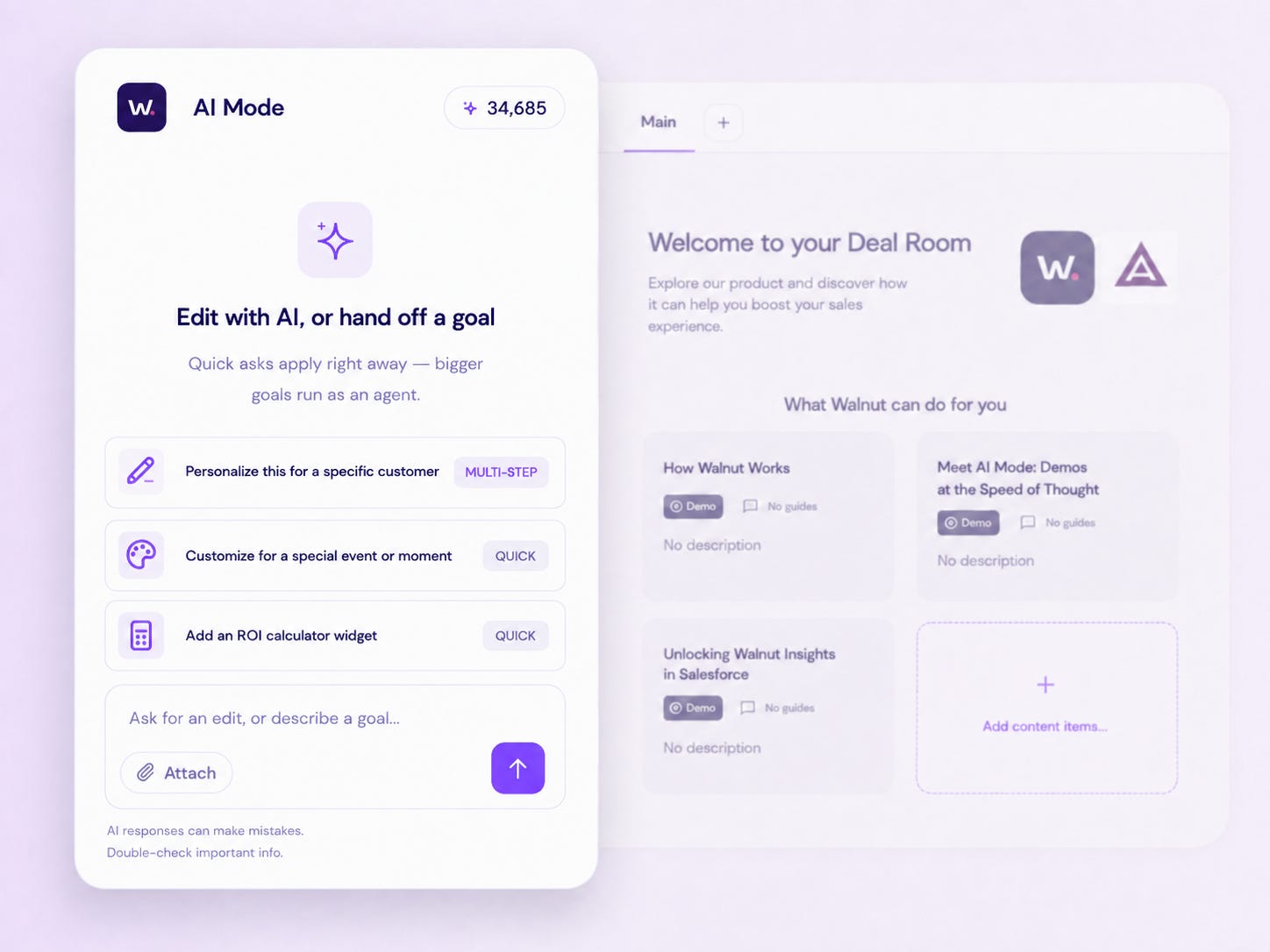
Walnut, the platform used by go-to-market teams at hundreds of B2B software companies to build interactive product demos, deal rooms, and buyer-facing content, has introduced a family of AI agents that covers both sides of the buying experience for the first time. Two agents are new. AI Mode for Playlists and Deal Rooms assembles a complete, personalized buyer-facing experience from a single prompt. Walnut Xpert sits on top of a demo and lets buyers ask questions and find their own way through the product. They join InsightsAI and AI Mode for demos, already live on the platform.
Coherence as a Product Requirement
Blank’s quote emphasizes telling a coherent story. The architecture of the platform is designed around that requirement. All four agents share the same foundation. Rather than generating content from a prompt and a guess at what the product looks like, Walnut’s agents work from the company’s own capture technology, which clones the actual product, its real screens, real flows, and real data, and builds every asset on top of that captured context.
The result is that when AI Mode assembles a demo or Walnut Xpert answers a buyer’s question, the output is anchored to what the product actually does. Walnut describes this as the architectural bet behind the announcement: a buyer’s journey holds together from first click to signed deal because every agent along the way draws on the same grounded context rather than starting from a blank page. A deal room assembled by AI Mode reinforces the story the demo already told rather than starting over.
Personalization at Full Scale
The second half of the strategy is reach. In Walnut’s telling, personalization stops being something a team builds for its five biggest deals and becomes something it builds for all of them.
Two data points support the claim. Deal room and playlist curation, which used to take an account executive or customer success manager roughly three hours per deal, now takes a sentence. Demo creation, over the past year of Walnut’s demo creation and personalization agents, has moved from days to hours to minutes, with greater fidelity and interactivity rather than less. A GTM team that once had to choose which accounts merited a tailored experience can now extend that experience across the pipeline.
The Buyer as a Source of Signal
Blank’s third clause, a buyer experience that helps the buyer make an informed decision, is where Walnut Xpert enters. Instead of a fixed, click-through path, a buyer can ask questions, go deeper on what matters to them, and find their own way through the product, guided by an agent grounded in the seller’s actual captured product.
Walnut reports that sessions with Walnut Xpert alongside a demo more than double the time a buyer spends. The questions asked generate intent signal a static demo never could. Walnut compares the effect to an AI SDR, qualifying interest and surfacing what buyers care about at a scale no team could staff for. Awareness activity that once yielded a click or a page view becomes a record of what buyers actually asked, in their own words.
AI Mode for Playlists and Deal Rooms in Practice
A seller describes what a specific buyer needs. The agent assembles a complete, personalized playlist or interactive deal room, drawing on the company’s captured product content, the buyer’s CRM record, and the seller’s stated intent. Because it works from the same grounded foundation as every other Walnut agent, the output reinforces rather than restarts the story.
The Model Question
Blank’s opening premise, that every company has access to the same frontier models, also explains Walnut’s decision to support bring-your-own-key (BYOK). Customers will be able to use their own model key, gaining direct control over security, privacy, and spend. Walnut’s position is that its verticalized buyer-enablement harness, the captured context, the workflows, and the governance, is the durable value, and it works with any underlying model. As frontier models keep improving, the quality and value customers get from Walnut’s agents improves with them, regardless of which model is doing the work underneath.
Governance as the Precondition
Before any agent with autonomy shipped, Walnut released the AI Center, a governance layer that gives administrators visibility, permissions, and guardrails over how AI is used across their workspace. The sequencing was deliberate. Agents that act on an organization’s behalf are only adoptable once someone inside that organization can see and control what they are doing, across every agent, in one place. BYOK support extends that layer.
Judgment Stays Human
In every case, the person on the GTM team remains the one who decided what story should be told and to whom. The agents execute from one shared, grounded context. The judgment stays with the humans who understand the account. That division is consistent with Blank’s framing: the strategic act of going to market well remains a human act, and the agents are there to carry it out at scale.
Availability
The AI Center, AI Mode for demos, AI Mode for Playlists and Deal Rooms, and Walnut Xpert are available to Walnut customers today. BYOK support, along with a companion MCP that lets customers run it from the AI provider of their choice, will roll out in the coming weeks.
Walnut describes itself as a vertical AI platform for product-led buyer enablement, built on a single agentic architecture that lets GTM teams direct one cohesive buying story instead of stitching together disconnected AI tools. On Blank’s reading of the market, that cohesive story is the thing worth competing on.