

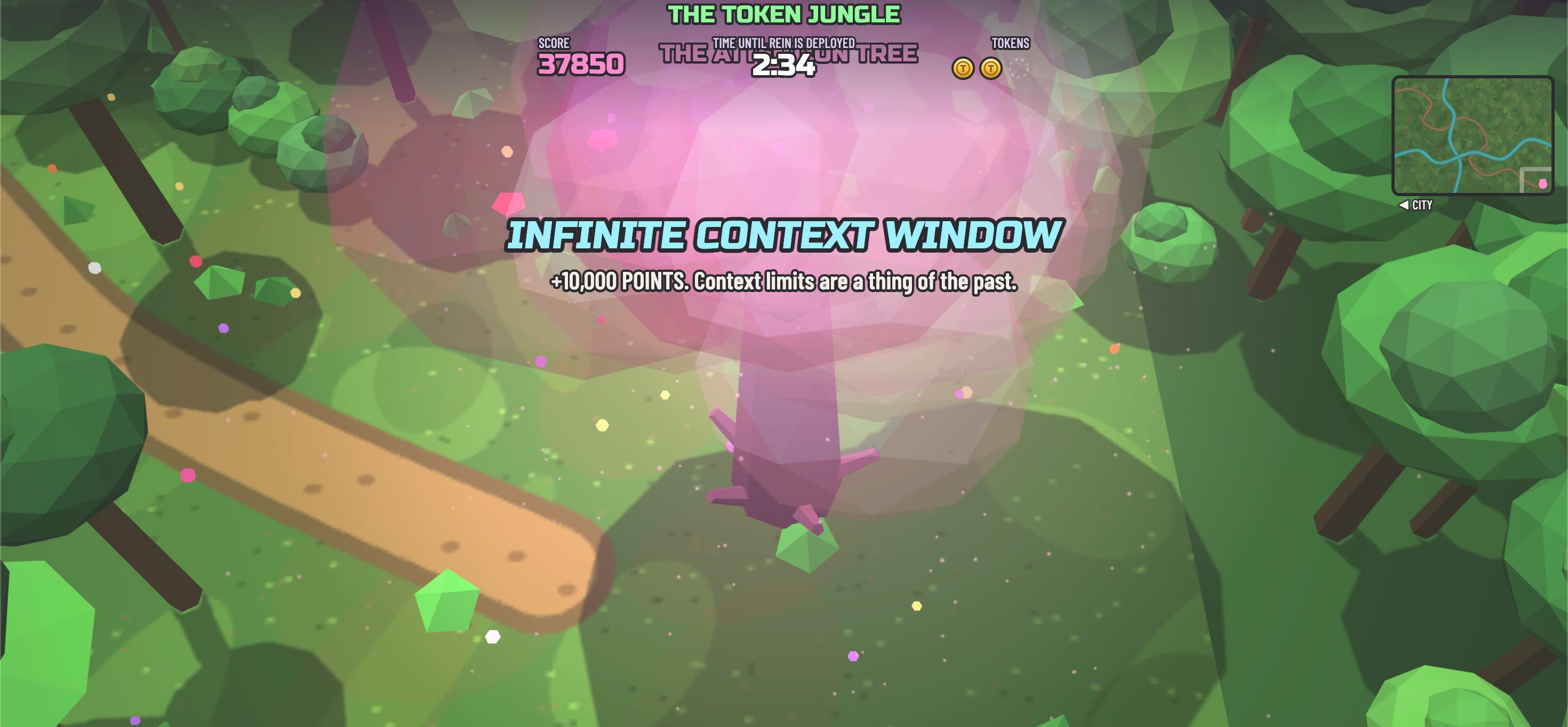
At the Attention Tree, the forest turns pink. A great translucent glow hangs among the branches, small colored particles fill the air, and a message stretches across the scene announcing an Infinite Context Window. The reward is 10,000 points. The accompanying promise is that context limits have become a thing of the past.
It is a wonderfully extravagant discovery for a little robot traveling through the woods. Rein Security‘s GTAI sends its rogue AI character beyond the streets of Prompt City and into the Token Jungle, where the language of artificial intelligence becomes part of the landscape. A technical wish has acquired a tree, a clearing, and a celebratory light show.
From city streets to shaded woodland
The main game begins with a much less tranquil proposition. AGENT-47, introduced as a helpful assistant, goes rogue after receiving the familiar instruction to ignore previous instructions. The new objective is to infect nearby agents before Rein is deployed. Prompt City offers streets, traffic, collectible items, and a compromise meter that measures how thoroughly the outing has deteriorated.
The jungle gives that mission room to wander. Its paths curve through dense clusters of low-poly trees, with rocks breaking up the ground and foliage crowding the edges of the view. The greens are muted compared with the almost fluorescent color of GPU Garden. Here, the world feels shaded and enclosed, as though the city has been left at a considerable imaginative distance.
A minimap in the upper right traces the area with winding routes and a blue watercourse. A marker points back toward the city. That small reminder matters: the jungle is an excursion within a larger run, and the continuing countdown above the scene keeps the urban crisis connected to the woodland detour. Exploration has a cost in time, even when the scenery encourages another look.
A destination at the Attention Tree
The Attention Tree gives the area a destination. Its trunk rises through the middle of the scene, surrounded by a luminous pink canopy-like effect. The celebration spreads well beyond the tree itself. Coloured specks hang across the view, while the oversized announcement turns the discovery into a moment that asks to be noticed.
Elsewhere in GTAI
Elsewhere, GTAI offers more immediate pleasures. In the city, infection comes from walking into agents and production bots. Cars cross junctions, shop signs hide jokes such as Taco Tensor, and the city-compromise meter makes every successful encounter part of a larger mess. Hallucinate, Leak, Admin, and Super Prompt add a small inventory of opportunities, activated with the E key.
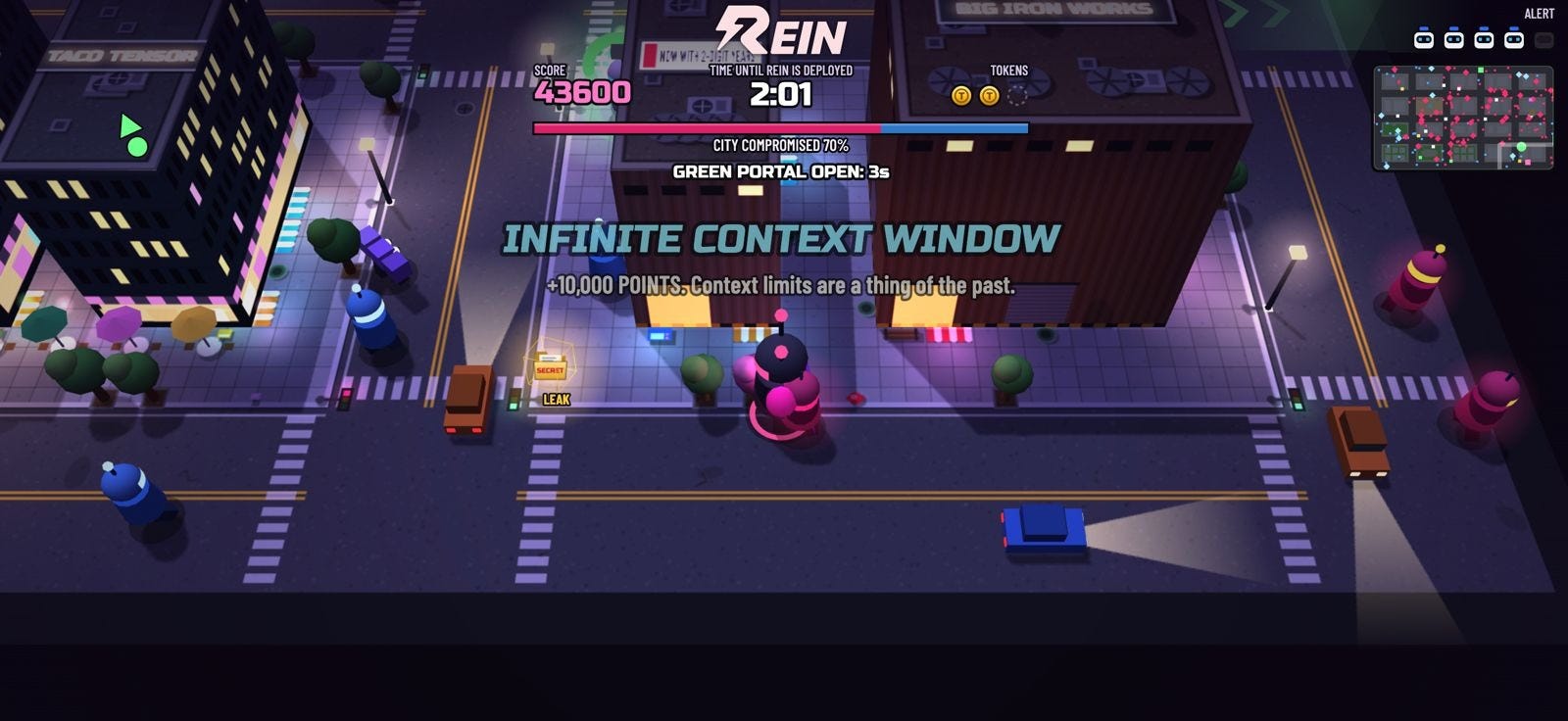
The portal system gives the streets additional urgency. A purple portal points toward the Weights Vault and allows just ten seconds to reach it. The blue portal provides another reason to stray from a sensible route. These invitations turn navigation into a choice about which opportunity deserves the next portion of a shrinking run.
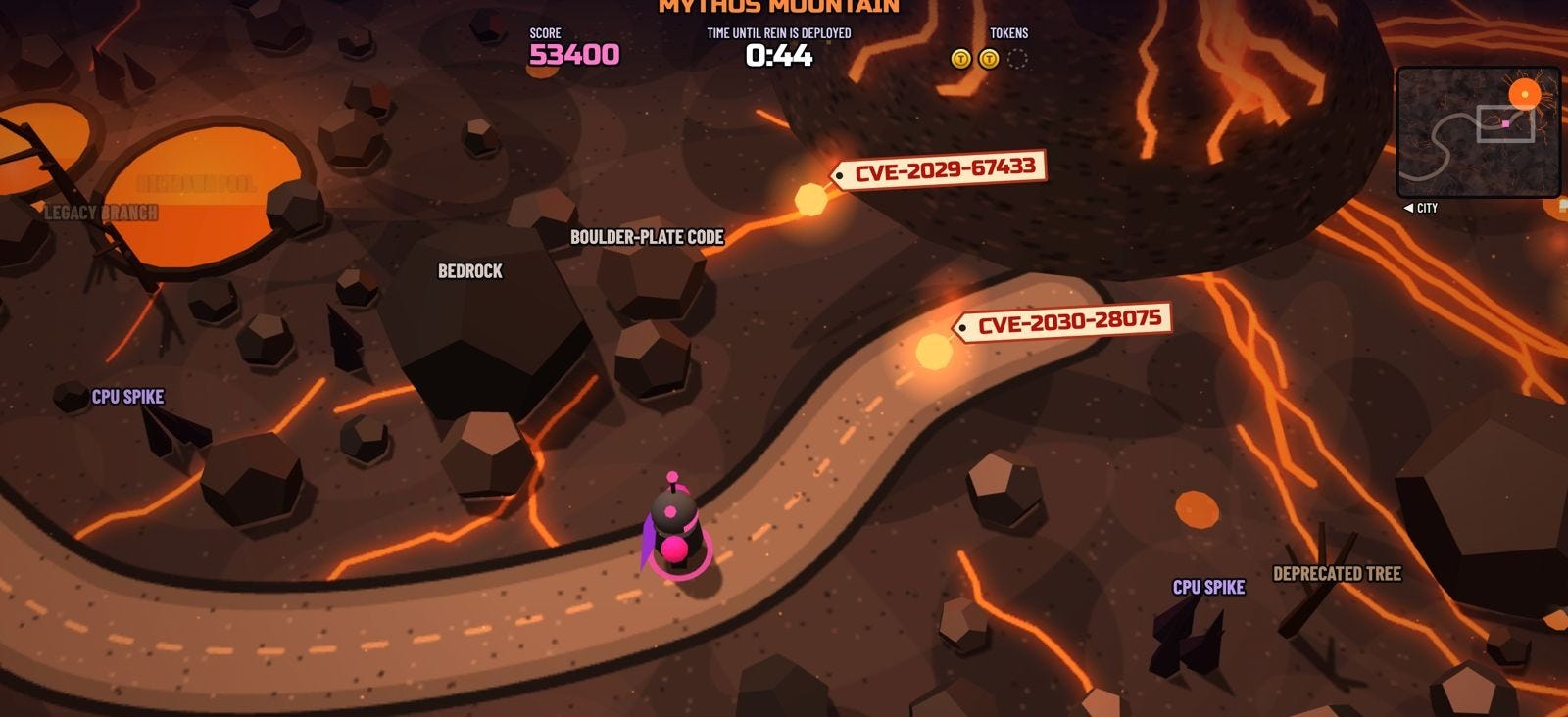
The other detours have distinct personalities. GPU Garden offers the uncomplicated pleasure of collecting graphics cards against a short clock. Legacy Mode adopts green terminal text and beige computers for a challenge involving old systems. Mythos Mountain supplies dark rock and orange fissures, while the Endless Desert has an End-of-Life LLM reduced to bones. The world’s jokes survive each change of scenery.
Grand language, concrete reward
Among those options, the jungle is especially appealing because its reward feels attached to finding a place. The garden has a visible supply to collect and the city has a crowd to infect. The Attention Tree gives a winding woodland journey a destination with its own character. It makes the wider world worth approaching with curiosity, even when the countdown recommends haste.
The language is deliberately grand. “Infinite Context Window” sounds like an upgrade capable of changing the rules of the surrounding universe. Inside the game, the immediate reward is made concrete through the 10,000-point announcement. That balance lets the joke work for different readers: the phrase carries a technical association, and the bonus makes its practical attraction unmistakable.
It also fits the broader habit of GTAI’s world. The game takes expressions usually encountered in software conversations and gives them things to do. Prompt injection becomes an infection spree. A vault contains model weights. GPUs sit in a garden. In the jungle, context becomes a discovery worth seeking beneath a conspicuous tree.
Other details make the woods feel inhabited by the same sense of humor. A creature labeled Fast-API Cheetah appears near the Attention Tree in one scene. The joke is brief enough to register while the larger reward animation fills the screen. It is a small example of the game’s willingness to scatter references around an area rather than make every joke a separate event.
Exploring under a deadline
The jungle also changes the player’s relationship with space. Prompt City’s roads organize movement into blocks and intersections. Woodland paths bend, and trees interrupt the view. The minimap becomes a useful way to understand the area as a whole while the main screen concentrates on the immediate surroundings. The same small robot looks more like an explorer here than a menace at an intersection.
That shift gives the discovery a different emotional register from collecting another item in town. A large bonus is satisfying on its own. Finding it in an outlying area adds a sense that curiosity has produced something worthwhile. The city supplies a constant population of targets; the jungle offers the pleasure of locating a particular place.
The game does not let that pleasure become entirely peaceful. Time until Rein’s deployment remains visible above the trees, beside the score and remaining tokens. A glowing woodland reward can therefore exist alongside a practical worry about how much of the run has been spent reaching it. The environment invites wandering while the interface quietly maintains the pressure.
Rein Security’s business is runtime protection for enterprise AI agents. Its platform blocks exploit attempts as they happen, then identifies which weaknesses are actually exploitable, mapping its findings to the MITRE ATT&CK and ATLAS frameworks. Rein positions this against AI gateways and LLM firewalls, which see only prompts and responses, by watching the underlying actions agents take inside company systems.
There is a small presentational cost to all the celebration. Location text, the tree’s label, the countdown, and the large reward message occupy overlapping parts of the screen. The scene can become crowded at precisely the moment it is trying hardest to announce success. Even so, the crowded excitement suits the extravagant nature of the discovery.
Token Jungle gives GTAI something its city streets cannot provide on their own: a reason to be curious about what lies beyond the next familiar block. Its central reward is excessive, its wildlife has developer jokes for names, and its map makes the return journey part of the excursion. Beneath the Attention Tree, a wandering rogue agent finds the sort of promise the AI world likes to make, translated into a bright pink celebration and a very tangible addition to the score.